Final Essay Reflection
When I first went into this challenge my two main goals were to be more cognitively present in nature and to reduce my time on my phone. Throughout this experience I feel that I made meaningful progress on both goals and also noticed improvement not only in my relationship to nature, but also in my stress levels and ability to focus on my assignments. Over the course of this challenge I also found that many of my experiences and activities that I did illuminate many of the concepts and ideas mentioned in our readings. By the end of the challenge I was able to discover new ways to integrate time outside more easily allowing me to meet my two main goals and hopefully further them in the future.
In using this challenge to build my connection to nature one of the central aspects was learning not only to be physically present outside, but also fully engaged through my senses.Many of my experiences aligned with Williams’ (2017) discussion on soundscapes as a way to treat and prevent many of our mental and physical problems.(pg.33) This idea deeply resonated through my experience as many of my highlights during these thirty days involved my senses. I loved feeling the sun on my body, listening to and watching the wind brush through the leaves, hearing the rain hitting the ground, and listening to birds sing on morning walks. I noticed that when I did not have my airpods in, like I usually do, I was able to appreciate and notice the natural sounds around me more fully. I found that after moments like these my mood always improved. These experiences also align with Kaplan’s (1989) concept of soft fascination, where nature effortlessly captures and retains our attention in order to allow for mental restoration. Similar to this idea after returning to my assignments after these moments I noticed I was able to focus more and had a more positive mindset.
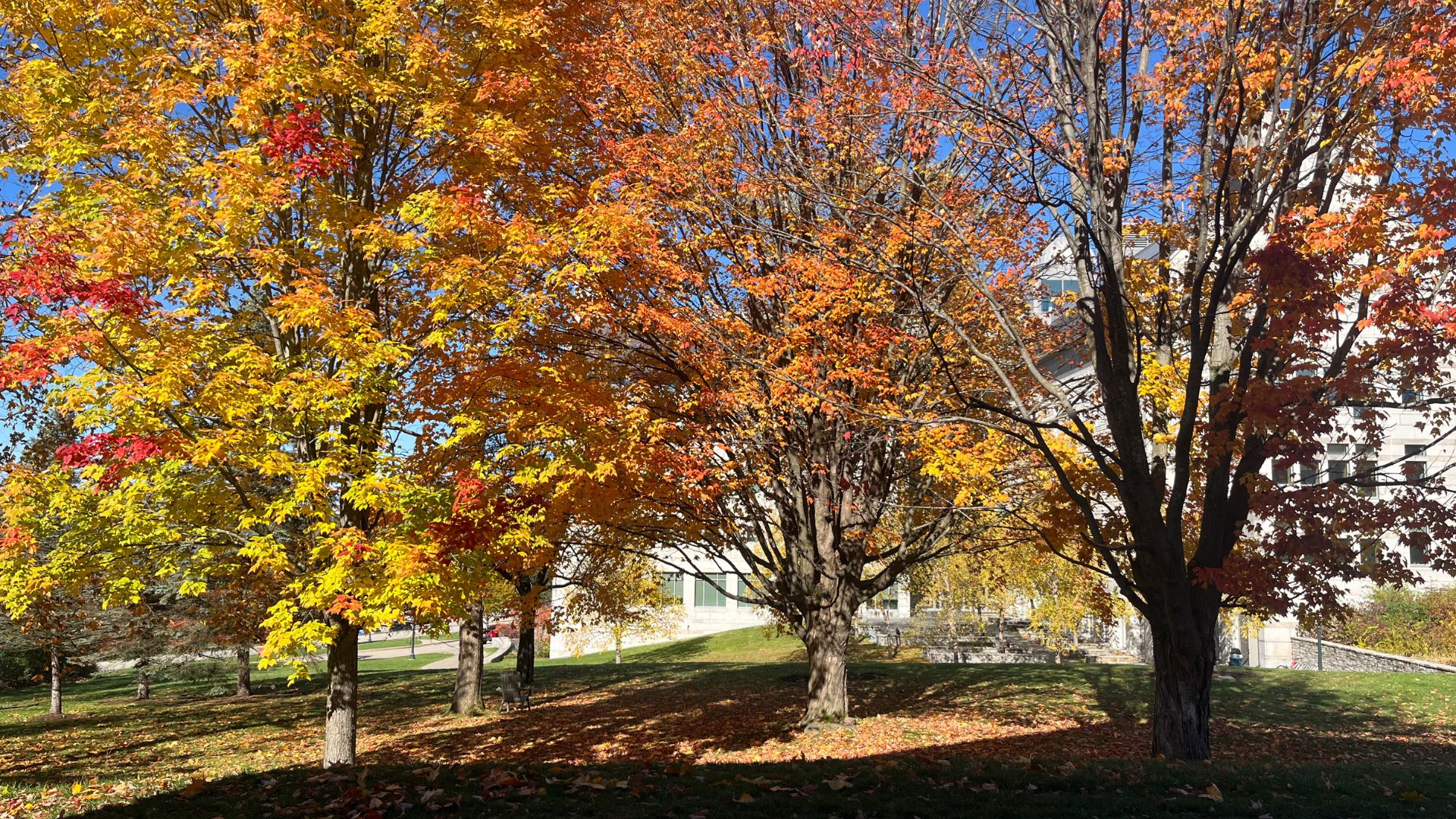
In regards to my second goal, on limiting my technology use, this is the one that I was the strictest on following and ended up being the most valuable during this challenge. Early on, not being on my phone was difficult as I found myself frequently having the urge to check it or use it to show my friends something I referenced when they joined me. As the challenge went on, since the intention of not being on my phone was there when I was alone I found myself focusing more on my surroundings as a way to distract from this urge. I would look at the trees, listen to the wind, and breathe in the fresh air. Additionally when I was with friends I purposely swayed our conversation away from digital references. The combination of continually being intentional, soft fascinations and changing conversational topics allowed me to be more comfortable not being on my phone. Once I was more comfortable and connecting more with my surroundings and whoever joined me I started to forget I had my phone on me. I found that the feeling I had toward not being on my phone reflected the concept of de-tethering from digital devices. As described by Lang & Borrle (2021), outside time in solitude is sought out by people who are looking for a way to move away from the constant distractions and stimulations that devices cause. Through my thirty days, I noticed just how easy it is to fully immerse myself in the present moment when I just eliminate the distraction that is my phone. However, I do think the concept of de-tethering is not only applicable when seeking solitude. Even when I was accompanied by friends, I still found myself being able to be present and our conversations were much more generative and reflective when we both restrained ourselves from using our phones. In the same vein, as mentioned by Sofija et al. (2022) my time outdoors was seen as a way of bonding and bringing me closer to my friends. When I had my friends join me, I found that my thirty minutes brought me a greater sense of joy and fun. These unstructured moments allowed for our conversations to be much deeper, reflective and enjoyable. I feel that this time felt more genuine because we did not have our phones. Therefore, in order to keep our conversation flowing we could not make digital references or ask each other simple questions about our classes and stress levels. As these topics are what we gravitate towards when having short unmeaningful conversations. Instead during my time outdoors we tended to talk about our childhoods and our hobbies. In having this phone free time we were able to focus on one another more allowing our conversations to be more meaningful and bringing us closer together.
Another concept from Lang & Borrle (2021) that also presented itself through my experience was the ideas of Societal Release. This idea was described as a form of seeking solitude in order to get away time from usual commitments and pressure placed by society. (Lang & Borrle, 2021) At the beginning of my challenge I actually found this difficult. When I would do my thirty minutes, I found myself constantly thinking about assignments and other tasks that needed to be completed. As the challenge continued my outdoor moments became a way to distract and center myself before returning to doing the tasks I had for the day. This was evident during an instance in which I sat outside on an adirondack chair, journaled and watched the sun set. When I initially sat down I was stressed because I was having trouble focusing on an assignment I needed to complete. Instead of wasting time stressing about it I decided to do my thirty minutes and sit outside. During this time I first began by journaling out all the thoughts that were running through my mind and this combined with a moment of silence to enjoy the view allowed me to feel calmer. Intentionally using this time to take a break made this time feel like a reset and let me go back to my assignments with a clearer mind. I started to look at my thirty minutes as moments of restoration rather than moments that were taking away time from my busy schedule. This was especially true when I started using the Mindfulness app, or when I would go outside for a walk. I found that in these moments I was easily able to work through my stressful thoughts and take time to have a break. In doing this my time outside became a way to relax from the constant overthinking that often accompanies my academic life. Based on my experience, I feel that one way that could help students deal with stress is by prioritizing leisure or break time that includes being phone free and taking in their natural surroundings. This overall implies that we need to find ways to allow people to prioritize taking a break in a society where we constantly uphold productivity over everything else.
Over the course of the challenge I discovered a way to connect with nature that allowed me to incorporate being alone or being with a friend, and allowed me to be fully immersed, this was walking. Initially, when I noticed that walking was the activity I gravitated towards the most, I worried it was not enough for this challenge. I also felt that it did not align with my initial rule of being more explorative in nature. This was initially important to me because I was influenced by others in the class who had goals to do very outdoorsy activities during this thirty day challenge. As time progressed I came to the realization that the activity didn’t matter because this experience was meant to be based on what worked for me, not on trying to do outdoor activities that I had not tried before or did not have access to because of my lack of a car. This allowed me to be aware that the activity I was doing didn’t matter as long as I was getting in my thirty minutes, without my devices, and enjoying the nature that surrounded me. Walking did this for me and also consistently improved mood and productivity throughout the day. My experience perfectly exemplifies Williams’ (2017) discussion on how going on walks helps to shift emotional and attentional states in a positive way. (pg. 47) Like this finding mentioned in her book, I too found walks to be my favorite take away activity from this challenge.
By the end of the challenge, I developed a deeper understanding of many of the concepts and benefits of being in nature that were present in our class readings. I was also able to find specific ways to be more physically and cognitively present in nature, so that going forward in trying to build my connection to nature even more I will be able to have a starting point. Overall my relationship to nature has become a lot more intentional and appreciative, as I now recognize and get to experience the benefits that come with spending time outside.
References
Kaplan, R., & Kaplan, S. (1989). The Restorative Environment. In The experience of nature: A psychological perspective (pp.177-200). Cambridge University Press.
Lang, Thomas, and William T. Borrie. “Wilderness Solitude in the 21st Century: A Release from Digital Connectivity.” International Journal of Wilderness, vol. 27, no. 3, Dec. 2021.
Sofija, E.; Cleary, A.; Sav, A.; Sebar, B.; Harris, N. How Emerging Adults Perceive Elements of Nature as Resources for Wellbeing: A Qualitative Photo-Elicitation Study. Youth 2022, 2, 366–383. https:// doi.org/10.3390/youth2030027
Williams, F. (2017). The nature fix: why nature makes us happier, healthier, and more creative. First edition. W.W. Norton & Company, independent publishers since 1923.

My Journey
Continue exploring my site!